
10% OFF

Spin the wheel of wishes KIMBERLI and win the main prize - DIAMOND
We give gifts with every paid order. Send your phone number and reserve your prize.
The prize will be selected using a randomizer. You will receive an SMS message with a promo code for the prize after placing your order.
The promotion is valid from 18.01.2026 to 01.02.2026
*The promo code can be received only once per phone number:
*Does not apply to products from the OUTLET category!
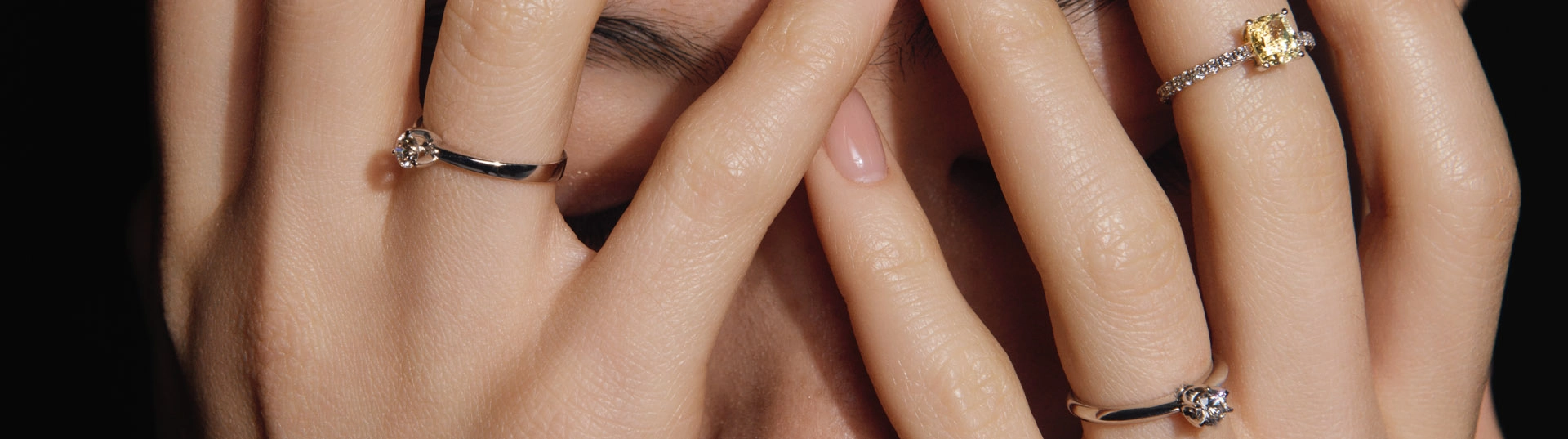

The question of lab-grown diamonds has become one of the most discussed topics in the jewellery industry over the past few years. Social media, marketing campaigns and fashion media have enthusiastically promoted "eco-diamonds" as a revolution in fine jewellery. But is that the full picture? Here's an honest, clear-headed look at what each option actually is — and why most people, on reflection, still choose a natural diamond.
A lab-grown diamond is a stone created in controlled conditions using one of two technologies: HPHT (high pressure, high temperature) or CVD (chemical vapour deposition). It has the same chemical composition as a natural diamond — pure carbon in a crystalline structure. In terms of hardness, refractive index and brilliance, it is identical.
Distinguishing a lab-grown diamond from a natural one with the naked eye is impossible. Even an experienced gemmologist without specialised equipment cannot tell which stone is which.
A natural diamond formed deep within the earth over billions of years, under conditions of extreme pressure and temperature. Every natural diamond is unique. Its inclusions, crystal form and character are the result of a one-of-a-kind geological process that cannot be replicated.
That uniqueness is the core value of a natural diamond — not simply as a stone with certain physical parameters, but as an object with its own history and origin.

Price. Lab-grown diamonds cost significantly less — typically 50 to 80% below natural diamonds of equivalent specifications. At first glance, this looks like a clear advantage. But there is another side to that equation.
Value over time. Natural diamonds hold their value and often appreciate over time — particularly well-certified stones with GIA documentation. The lab-grown diamond market is moving in the opposite direction: prices fall every year as the technology becomes cheaper and more widely available. A stone purchased today for $1,000 may be worth $300 in five years.
Uniqueness. A natural diamond is the only one of its kind. A lab-grown stone with identical specifications can be produced again tomorrow. For an engagement ring or a piece of jewellery intended to become a family heirloom, that distinction carries real weight.
Environmental impact. The marketing around lab-grown diamonds leans heavily on environmental arguments. But the production of lab-grown diamonds is an extraordinarily energy-intensive process. Without the use of renewable energy sources, the carbon footprint of that production can be comparable to — or in some cases greater than — conventional mining.
Emotional value. A diamond that took three billion years to form and travelled from deep within the earth to your hand carries something a lab-grown stone simply cannot reproduce. For a piece of jewellery given as a declaration of love, or passed down through generations, that matters.

Our collection features exclusively natural, certified diamonds. This is a considered decision — not a refusal to engage with new technology, but a clear understanding of what our clients are actually buying.
A natural diamond in a Kimberli piece is a stone with a GIA or IGI certificate, confirmed parameters and guaranteed origin. It will not lose its value because the technology used to produce a similar stone has become cheaper. It will not become commonplace.
We understand that for some buyers, a lab-grown diamond may be the right choice — for example, when the priority is maximum visible stone size within a defined budget, or when the decision is purely aesthetic with no expectation of long-term value. For those clients, we produce pieces with lab-grown diamonds by individual order.
But for the majority of our clients — those buying an engagement ring, a gift for a significant occasion, or a piece they intend to wear and keep for years — a natural diamond remains the only truly right choice.
The straightforward and reliable answer is a certificate. GIA (Gemological Institute of America) and IGI (International Gemological Institute) are the most respected independent laboratories in the industry. A certificate carries the stone's unique identification number, all of its parameters, and confirms its natural origin.
At Kimberli, every diamond of 0.3 carats and above comes with a certificate — so that you know precisely what you are buying and can be confident in the lasting value of your piece.
Lab-grown diamonds are a real technology with genuine advantages in certain situations. But a natural diamond remains what it has always been: unique, irreplaceable and the only stone that becomes more valuable — not less — with the passage of time.