
10% OFF

Spin the wheel of wishes KIMBERLI and win the main prize - DIAMOND
We give gifts with every paid order. Send your phone number and reserve your prize.
The prize will be selected using a randomizer. You will receive an SMS message with a promo code for the prize after placing your order.
The promotion is valid from 18.01.2026 to 01.02.2026
*The promo code can be received only once per phone number:
*Does not apply to products from the OUTLET category!
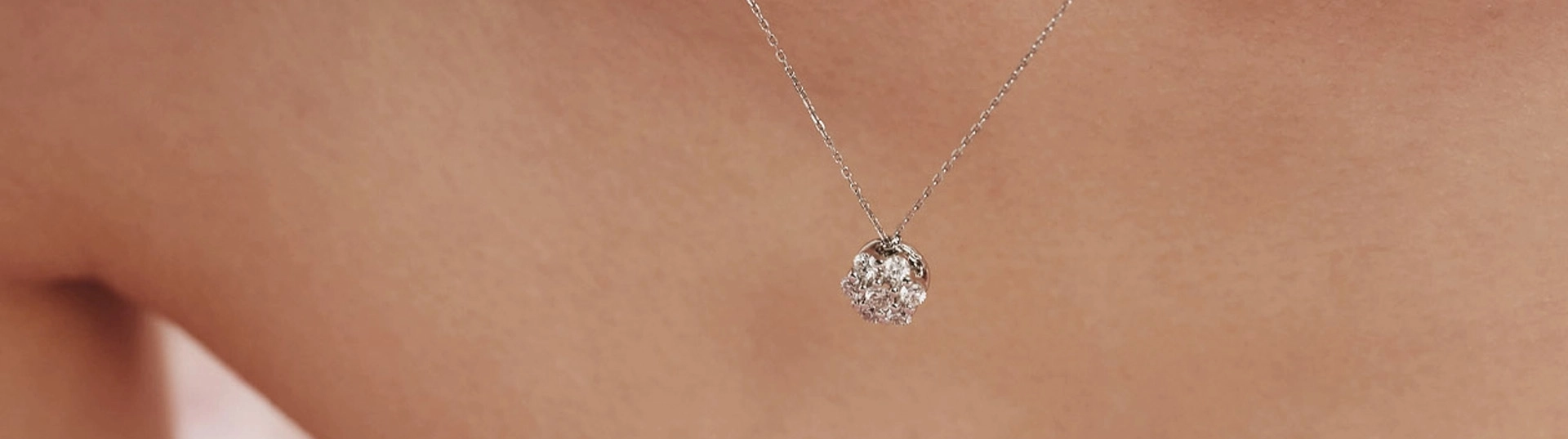

If a ring speaks to status and earrings reveal character, a diamond necklace or pendant speaks to taste. It sits on open skin, draws the eye to the neckline and sets the tone for the entire look from the moment it's seen. Which is precisely why choosing the right piece deserves more thought than it might first appear.

These two terms are often used interchangeably, but the distinction matters.
A pendant is a separate decorative element — a diamond or cluster of diamonds — attached to a chain. The chain is typically fine and simple: its job is to hold the pendant, not to compete with it. Pendants come in almost any shape: teardrop, heart, flower, geometric form or the classic solitaire suspended on a delicate chain.
A necklace is a single unified piece in which the chain and the stones form one continuous design. Diamonds may run the full length or be concentrated in the centre. A diamond necklace has more presence and visual weight than a pendant and often works as a standalone statement that needs nothing else around it.
A simple pendant on a fine chain is an everyday piece. A diamond necklace is for evenings and special occasions.
Shape and style. The classic choice is the solitaire pendant: one diamond in a setting on a slender chain. It suits every outfit and every neckline. For something more expressive, a teardrop or pear-shaped pendant offers movement — the elongated stone catches and returns light differently with every step.
Stone size. For everyday wear, diamonds between 0.1 and 0.5 carats keep the pendant visible without overwhelming the look. For evenings out or formal occasions, 0.5 carats and above creates the kind of presence that reads across a room.
Chain length. This matters more than most people realise. A 40–42 cm chain places the pendant at the base of the throat — classic, polished, ideal with an open neckline. A 45–50 cm chain drops the pendant to the sternum — versatile and flattering for most outfits. Longer chains from 55 cm create a more relaxed, layered aesthetic.
Gold colour. White gold enhances the cool brilliance of a diamond and reads as contemporary. Yellow gold creates a warm contrast and evokes the quality of vintage fine jewellery. Rose gold is the most romantic choice, particularly beautiful with smaller diamonds where the warmth of the metal and the cool of the stone complement rather than compete.
Tennis necklace or diamond line — a continuous row of diamonds along the full length or central portion of the piece. This is the most enduringly classic option, and it reads as expensive even at relatively modest total carat weights. It is the natural choice for evening wear and formal events.
Necklace with a pendant centrepiece — combines both elements: a diamond-set chain with a more prominent stone or cluster at the centre. This is a richer, more complex piece for those who want their jewellery to be an unambiguous statement.
Delicate diamond necklace — a fine chain with small pavé diamonds or a single stone at the centre. The minimalist choice for everyday wear that still catches light and draws attention without announcing itself.

Neckline and pendant shape. A round or oval neckline is beautifully complemented by a teardrop pendant or a diamond line necklace. A deep V-neckline calls for a longer pendant that echoes and follows the shape of the cut. A high neck or turtleneck creates an ideal backdrop for a short necklace or a pendant that sits directly at the throat.
The single-accent rule. If you are wearing a diamond necklace, your earrings should be understated — studs or small hoops. If your earrings are bold and prominent, keep the necklace simple. Two expressive pieces worn simultaneously compete with each other and pull the look apart rather than holding it together.
Layering. Multiple fine chains of different lengths worn together is a strong contemporary trend that works well in everyday dressing. The key word is fine: statement diamond necklaces are worn alone, not layered.
Colour and contrast. White gold and diamonds work on virtually any dark background — black, navy, deep green, burgundy. Yellow gold pairs most naturally with warm tones: ivory, white, camel, terracotta. On bold colours, diamonds are still beautiful but the piece should be simple, so the jewellery and the colour don't overwhelm each other.
A diamond necklace or pendant isn't just an accessory — it's the final detail that completes a look, or sometimes the detail that defines it. The principles are straightforward: the diamond should be visible, the neckline open, and the overall look should have one clear focal point. Get those three things right, and everything else follows.