
10% OFF

Spin the wheel of wishes KIMBERLI and win the main prize - DIAMOND
We give gifts with every paid order. Send your phone number and reserve your prize.
The prize will be selected using a randomizer. You will receive an SMS message with a promo code for the prize after placing your order.
The promotion is valid from 18.01.2026 to 01.02.2026
*The promo code can be received only once per phone number:
*Does not apply to products from the OUTLET category!
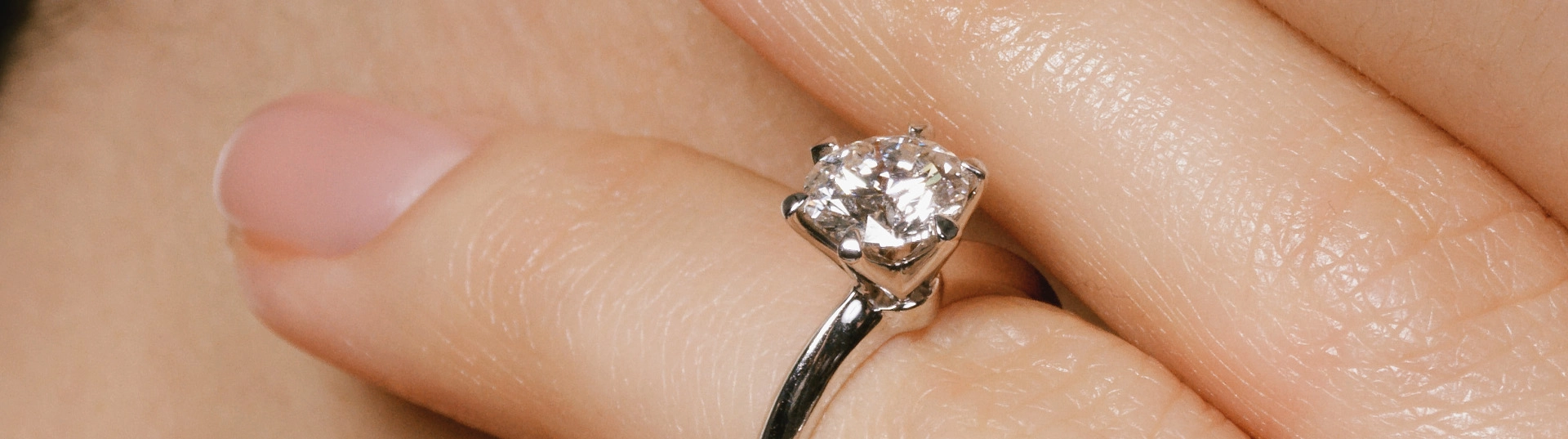

The word "solitaire" comes from the French for "alone" — and that's exactly the point. One ring, one stone, nothing else. This deliberate simplicity is what made the solitaire the universal symbol of an engagement proposal. But what actually sets a solitaire apart from any other ring with a diamond, and which cut will make the stone shine its brightest?
A solitaire is a ring with a single centre stone that serves as the sole focus of the design. No side stones, no pavé, no diamond bands running along the shank. Just the band and the stone.
That said, not every ring with one stone is a solitaire. The defining feature is an open setting that lifts the stone above the band and allows light to pass through it from every direction. This is precisely what produces the characteristic brilliance that makes solitaires instantly recognisable.
The most classic setting is the prong setting — four or six slender metal claws that secure the stone while exposing as much of it as possible. Four prongs make the diamond appear larger; six prongs hold it more securely but conceal a little more of the stone's shape. The bezel setting, which encircles the stone with a continuous rim of metal, offers a more contemporary and protective alternative, though it sacrifices some of the open, airy quality of the traditional prong.

In a solitaire, the stone is the entire story. The cut choice matters more here than in virtually any other ring style.
Round brilliant cut is the undisputed classic and the most popular choice for solitaires worldwide. Its 57 or 58 facets are precisely engineered to return as much light as possible to the viewer's eye. The result is maximum brilliance and fire. If you're uncertain which cut to choose, the round brilliant is always the right answer — it suits every style and looks appropriate in every setting.
Oval cut is the second most popular choice and has surged in demand over the past five years. It elongates the finger, offers a slightly larger visible surface area than a round stone of equal carat weight, and produces a similar quality of light return. An excellent choice for those who want something a little less expected without straying from the classics.
Princess cut — a square or rectangular stone with sharp corners — delivers a distinctly modern look. The sharp corners are more vulnerable to chipping, so a secure prong setting at each corner is essential.
Pear cut resembles a teardrop. Asymmetric and expressive, it suits those looking for something distinctive. It can be worn point-up toward the nail or point-down toward the wrist — both orientations are entirely correct.
Cushion cut — a square shape with softly rounded corners — feels warmer and more romantic than the princess, with a vintage quality that appeals to those drawn to heritage aesthetics. It tends to produce more "fire" (coloured light flashes) than the round brilliant's concentrated "brilliance" (white light return).
Marquise cut is an elongated oval with pointed ends. Dramatically beautiful on the finger and particularly flattering for elongating the hand. Like the princess cut, the pointed ends require careful attention to the setting to protect against damage.

The distinction isn't primarily about the stone — it's about the concept and construction.
The setting. In a solitaire, the stone is always elevated and maximally exposed to light. If the stone sits flush with the metal, or is surrounded by additional diamonds, it isn't a solitaire in the traditional sense.
Single-stone focus. Nothing in the design competes with the centre stone for attention. The band is intentionally slender and understated — the metal exists only to support the stone, not to contribute its own visual weight to the design.
Stone quality. Because the stone is fully exposed on all sides with nothing to obscure it, any inclusions or imperfections in the cut become visible. For this reason, solitaires demand higher-quality stones than ring styles where a centre diamond is surrounded by pavé or flanked by side stones that draw the eye and provide visual cover.
Perceived size. There is nowhere to "hide" a small stone in a solitaire — it is always the centre of attention. A well-cut diamond in a quality solitaire setting reads as larger and more significant than the same stone set in a more complex design.
A solitaire is a choice made by those who understand that restraint is its own form of luxury. One stone, the right cut and an expertly executed setting say more than any accumulation of additional detail. It's why solitaire rings have been the first choice for engagements for over a century — and why they show no signs of changing.